
Monroe County Projected Versus Actual Release
Tennessee’s public state system does not use the phrase projected release date. TDOC FOIL details use Release Eligibility Date and Sentence End Date. Eligibility is the calculated point when a release mechanism or parole consideration may become available. It is not a Board grant. Sentence End Date is the calculated endpoint, although parole can place a person in the community before that endpoint while the sentence continues.
Scheduled versus actual: A calculation forecasts a legal milestone. TDOC’s CR-1947 release authorization supplies the stronger physical Date of Release and Released To fields.
A Monroe County pretrial detainee has no sentence-based release date. Release may turn on bond, dismissal, or a new court order. A locally sentenced person may have a jail calculation, while a state felony prisoner has TDOC calculations. The Sheriff-linked Citizen Connect portal answers county release dates after the booking closes but not the release time, reason, or destination.
Find a Monroe County Projected Release Date
Classify custody before trusting a date. FOIL covers current and former Tennessee felony custody or supervision, not every county-only booking. The Monroe jail and court are the better sources for a local sentence or pending charge. The Monroe County release record search supplies the broader path when custody is unclear.
- For a state case, open TDOC FOIL search. Use TDOC/TOMIS ID or SID when known, or search by name, race, and aliases.
- Match birth date, identifiers, and physical details. Read Supervision Status and Assigned Location before interpreting any date.
- Compare Release Eligibility Date, Sentence End Date, active sentences, and Parole Hearing Result. Do not turn eligibility into a promised departure.
- For a local jail sentence, contact Jail Administration and the Monroe Circuit Court Clerk for the calculation and governing order. A pretrial case may have no set date.
- For an exact past state release, request CR-1947 or archived discharge records from TDOC Records Management.
The FOIL search form accepts last name, first name, race, aliases, TDOC ID, and SID, then requires a CAPTCHA. A unique number is safer than a name alone.
Open the official TDOC FOIL search shown in the captured search screen.
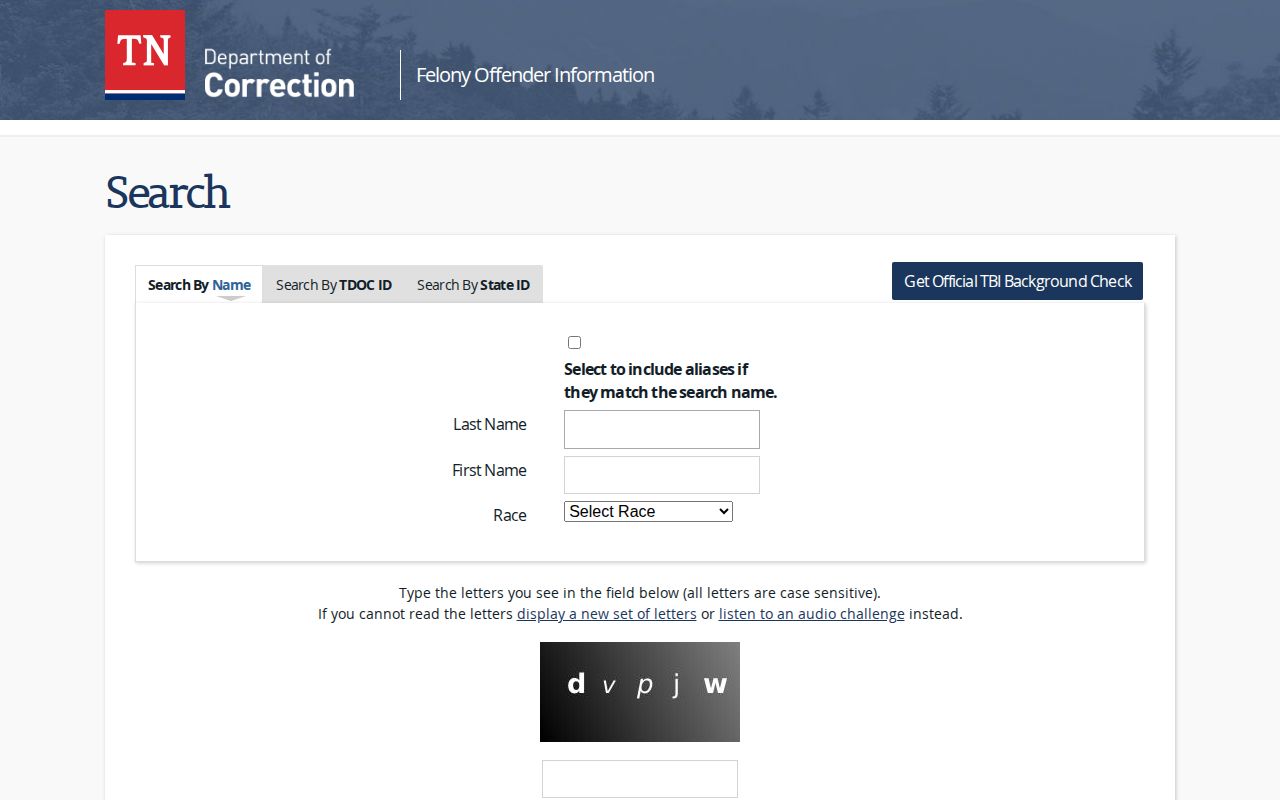
The form’s fields help identify the correct state record before any Monroe County release date is read.
Note: MyTN offers FOIL as a mobile state channel, but no official Monroe Sheriff release app was found.
Monroe County Release Credit Calculations
Tennessee Code § 41-21-236 permits sentence-reduction credits under defined rules. Credits can range from one to sixteen days per month served, including up to eight for good institutional behavior and up to eight for satisfactory program performance. They are a privilege. They may be withheld or removed through discipline, are not earned in maximum-security classification or punitive segregation, and are limited in a month with specified disciplinary findings.
Some qualifying educational or intensive residential treatment achievements can support a one-time sixty-day credit, subject to exclusions. The effect also changes by offense and sentence date. For qualifying offenses before July 1, 2024, and sentences under two years for offenses on or after that date, the statute applies credits as prescribed. For a sentence over two years tied to an offense on or after July 1, 2024, credits may reduce time to parole eligibility but do not change sentence expiration.
Parts of the framework extend to a felony term of at least one year served in a local jail or workhouse. A jail administrator may recommend up to eight days per month for qualifying pre-sentence jail time, but the law creates no entitlement to that recommendation. Misdemeanor sentences use a court-selected release percentage, and credits cannot reduce that percentage by more than twenty-five percent. These distinctions are why Monroe County Jail Administration and the sentencing court must handle local calculations.
Note: Sentence credits are conditional calculations, not a promise that a Monroe County release will occur on a certain day.
Monroe County Release Eligibility Rules
The familiar Tennessee “85 percent” phrase is not a rule for every sentence. Section 40-35-501 applies an offense-date and offense-specific framework. For enumerated offenses committed on or after July 1, 1995, subsection (i) requires service of the full sentence less earned and retained credits, with those credits unable to reduce service by more than fifteen percent. The resulting floor can be 85 percent, but no automatic fifteen-percent award exists.
Newer provisions make the shortcut less reliable. Subsection (bb) requires 100 percent with no release eligibility for listed offenses committed on or after July 1, 2022. Subsection (cc) creates another 100-percent group in which specified program credits can affect parole eligibility by no more than fifteen percent without changing sentence expiration. Other statutes add more offense-specific rules.
TDOC calculates felony sentence expiration and eligibility for state sentences and felony terms of at least one year served locally. Only qualifying felony sentences longer than two years, or consecutive terms totaling more than two years, generally receive parole consideration, subject to exceptions. The precise offense, date, judgment, sentence structure, and retained credits must be used. A broad percentage cannot replace the official calculation.
Parole eligibility creates an opportunity for Board consideration, not a right to release. Life without parole is ineligible, and other terms depend on the statute that governed the offense. A hearing calendar proves only scheduled review. Even a grant can precede plan approval, required documents, and the actual release authorization. That sequence explains why the same Monroe County state case may show an eligibility date, a hearing result, and an incarcerated status at the same time.
Note: Apply the statute in force for the offense date instead of relying on a broad 85-percent rule.
Why Monroe County Release Dates Change
FOIL warns that dates can change when more court documents arrive. A sentence calculation is built from records and rules that may be corrected or updated. The table identifies the researched factors and the source that should resolve each one.
| Factor | Possible effect | Best confirmation |
|---|---|---|
| Judgment or corrected order | Changes sentence length, offense data, or release terms | Sentencing clerk and TDOC calculation |
| Concurrent or consecutive terms | Changes the combined sentence sequence | Court judgments and FOIL active sentences |
| Pretrial jail credit | Adds qualifying time already served | Court order and sentence records |
| Earned or lost credits | Moves eligibility where statute permits | Institutional records and TDOC |
| Detainer or another hold | Can lead to another agency’s custody instead of community release | Jail, VINE, court, and receiving agency |
| Parole decision | May authorize earlier community supervision or continue confinement | Board result, FOIL status, and CR-1947 |
A grant can be followed by release-plan review or other prerequisites. A denial continues confinement subject to later review. Neither result should be read without the current Incarcerated, Parole, Probation, or Inactive status.
FOIL Monroe County Release Date Labels
Angle O is central to this lookup: Tennessee publishes eligibility, not a promised projected gate date. The FOIL detail record can show name, birth date, TDOC ID, SID, photograph, physical description, aliases, Supervision Status, Assigned Location, combined sentence length, custody level, sentence dates, and hearing details. Read the whole record. An Inactive status with no active Tennessee sentences supports a former state case, while archived release documentation is stronger.
| FOIL field | What it means |
|---|---|
| Supervision Status | Current state relationship, such as incarcerated, parole, probation, or inactive |
| Assigned Location | Institution or supervision placement shown by TDOC |
| Release Eligibility Date | Calculated eligibility milestone, not physical release |
| Sentence End Date | Calculated sentence endpoint |
| Parole Hearing Result | Board action, which may precede release requirements |
Review the official FOIL detail format captured for the release-date fields.
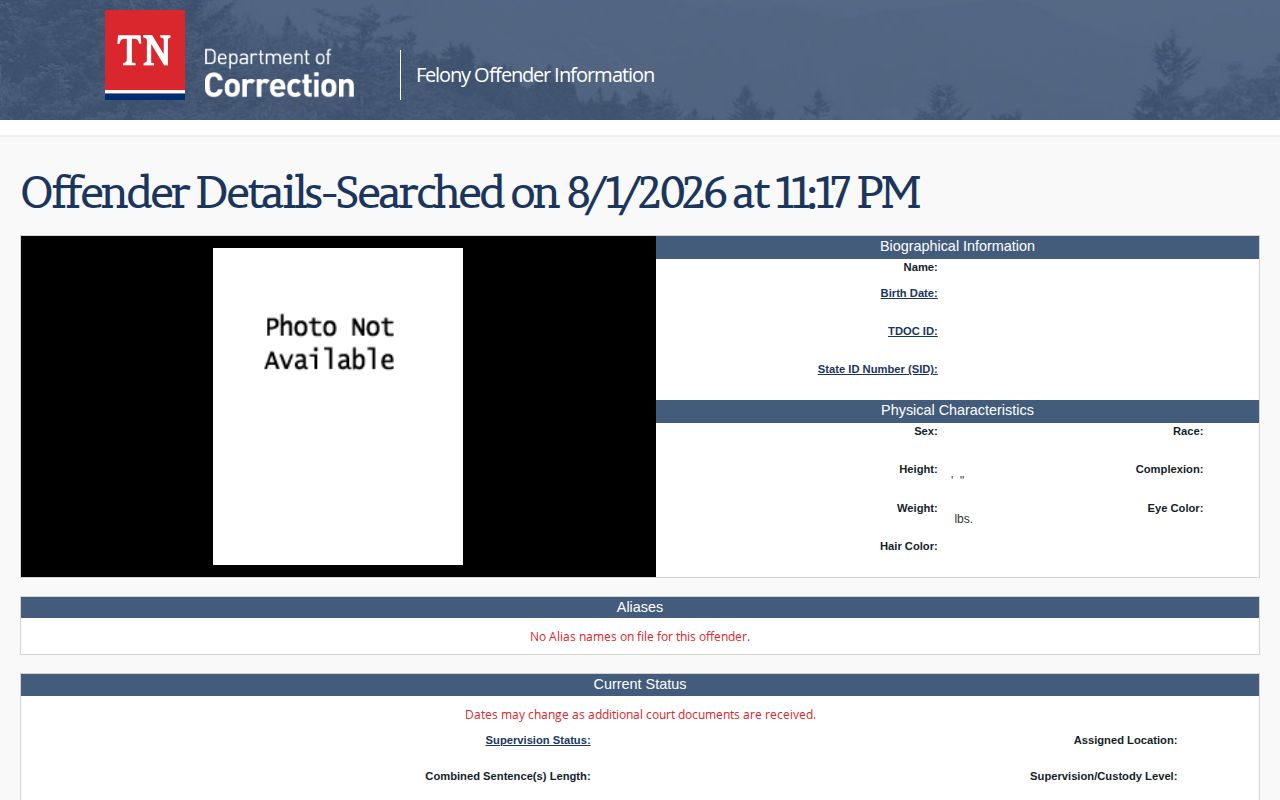
The detail screen shows why status, eligibility, sentence end, and hearing result must be read together.
Correct a Monroe County Release Date
For a person still in TDOC custody, the offender handbook’s administrative correction path begins with form CR-3118 to the counselor. It then proceeds through institutional Records and Sentence Information Services. If the issue remains unresolved, the documented path can reach a declaratory-order petition to TDOC General Counsel. Supporting judgments, jail-credit orders, and identity records matter.
A released person seeking an archival correction should contact TDOC Records Management and the sentencing clerk with the exact order. Records Management is in the Rachel Jackson Building, second floor, 320 Sixth Avenue North, Nashville, TN 37243-0465, and can be reached at 615-253-8079. A county-only error belongs with Sheriff Tommy J. Jones II’s Jail Administration, County Finance for the documentary jail record, and the court that entered the order.
State release documentation carries more detail than the public FOIL screen. CR-1947 includes identity, sentence effective and expiration information, eligibility fields, location and custody, Released By, Date of Release, Released To, release address, and operational checks. It can also record property, money, clothing, identification, GPS, and state ID or license steps. Some personal details may be withheld or redacted, but the form is the best researched state artifact for separating a computed milestone from physical departure.
A targeted request should state the TDOC ID, full name, date range, sentencing court, and the exact release or discharge document sought. For a local record, include the Monroe booking number and ask for release date and time, release authority or type, and destination or receiving agency. The public Citizen Connect card does not expose those final fields, so a formal request may be needed when a transfer or hold is possible.
Confirm Monroe County Release Dates
Use the source that performed the action. A Monroe jail release report is stronger than disappearance from Current Confinements. A filed court order explains the authority. For a state gate departure, CR-1947 is stronger than an eligibility field because it records Date of Release and Released To. FOIL supplies current status and sentence context.
VINE release notifications can alert to an agency-reported release, transfer, sentence expiration, or eligibility event. VINE is useful corroboration, not a judgment or authorization. If the county booking ended and VINE or FOIL shows TDOC custody, the person transferred and did not enter the community.
For a pending local case, call Jail Administration at 423-442-3911, option 3, and check the order through the Monroe County judicial offices. For a state case, verify through FOIL and TDOC Records Management. This two-source method separates a forecast, a Board decision, and an actual release.
Federal and immigration dates sit outside these systems. A BOP locator result addresses federal custody, while ICE uses its own detainee locator and limited recent-release visibility. Monroe Citizen Connect may preserve an earlier local booking, but it cannot prove what later happened under federal authority. Choose the locator that held the person before comparing dates.