
Monroe County Parole Versus Probation
Parole and probation can both place a person in Monroe County while a public agency still supervises the case, but they begin in different ways. The Tennessee Department of Correction release types describe parole as Board-authorized community release before the sentence expires. TDOC Community Supervision manages the conditions. A Board grant alone is not proof that the person left custody because an approved plan and other pre-release steps may still be pending.
Probation comes from a court order. It may start instead of confinement or after split confinement, which combines jail time with community supervision. TDOC says a person placed on probation or released from split confinement must report within 48 hours. The filed Monroe County order remains the best source for the sentence terms, while FOIL is the practical public check for state supervision.
| Point | Parole | Probation |
|---|---|---|
| How it starts | Board authorizes release before sentence expiration | Court imposes a community sentence or split-confinement term |
| What continues | The prison sentence continues under supervision | The court sentence continues under ordered conditions |
| Public check | FOIL status, Board result, and release authorization | FOIL status and the Monroe County court order |
| Local contact | TDOC Monroe/Meigs field office | TDOC Monroe/Meigs field office when TDOC supervises it |
A county bond release is neither parole nor probation unless a separate order creates supervision. Citizen Connect can show that a Monroe jail booking ended, but it does not show the release reason or destination on the public card.
Check Monroe County Supervision Records
The correct search depends on the legal source. TDOC Felony Offender Information Lookup, or FOIL, covers people currently or formerly in Tennessee felony custody or supervision. It does not cover every Monroe County bond release or county-only misdemeanor. Search the person, then interpret status and location together.
- Use a TDOC or state identification number when known. Otherwise enter the last and first name, add race or aliases when useful, and complete the CAPTCHA.
- Compare birth date, physical identifiers, and IDs before opening a record. Similar names are not enough.
- Read Supervision Status first. Parole or probation generally points to community supervision; incarcerated means state confinement; inactive supports a former TDOC case but does not explain why it closed.
- Review Assigned Location, Sentence End Date, Release Eligibility Date, and Parole Hearing Result together. Eligibility and a favorable hearing are not physical-release proof.
- Confirm the local supervision route with the Madisonville TDOC office. Obtain the court order or TDOC release authorization when an exact legal status or release date matters.
For a jail-only case, start with Monroe Citizen Connect and the criminal court file instead. The full Monroe County released inmate search path explains how a release card, court disposition, VINE event, and state record fit together.
Note: A person leaving Monroe custody for TDOC remains incarcerated even though the county booking displays a Released badge.
Monroe County Supervision Field Office
Monroe and Meigs Counties have a dedicated office in Madisonville within TDOC District 30. The official field office directory is the source to recheck before a visit. Staff can clarify the route for Tennessee parole or probation supervision. The office is not the proper source for a county-only bond release, a jail booking report, or a federal supervision question.
TDOC Probation and Parole Office
123 Pedigo Road
Madisonville, TN 37354
Phone: 423-442-7409
Fax: 423-442-7418
District: 30, Monroe/Meigs office
The directory screenshot shows the expanded Monroe/Meigs listing within District 30. It provides a direct local route after FOIL identifies state supervision.
View the TDOC field office directory entry used to locate Monroe County supervision contacts.
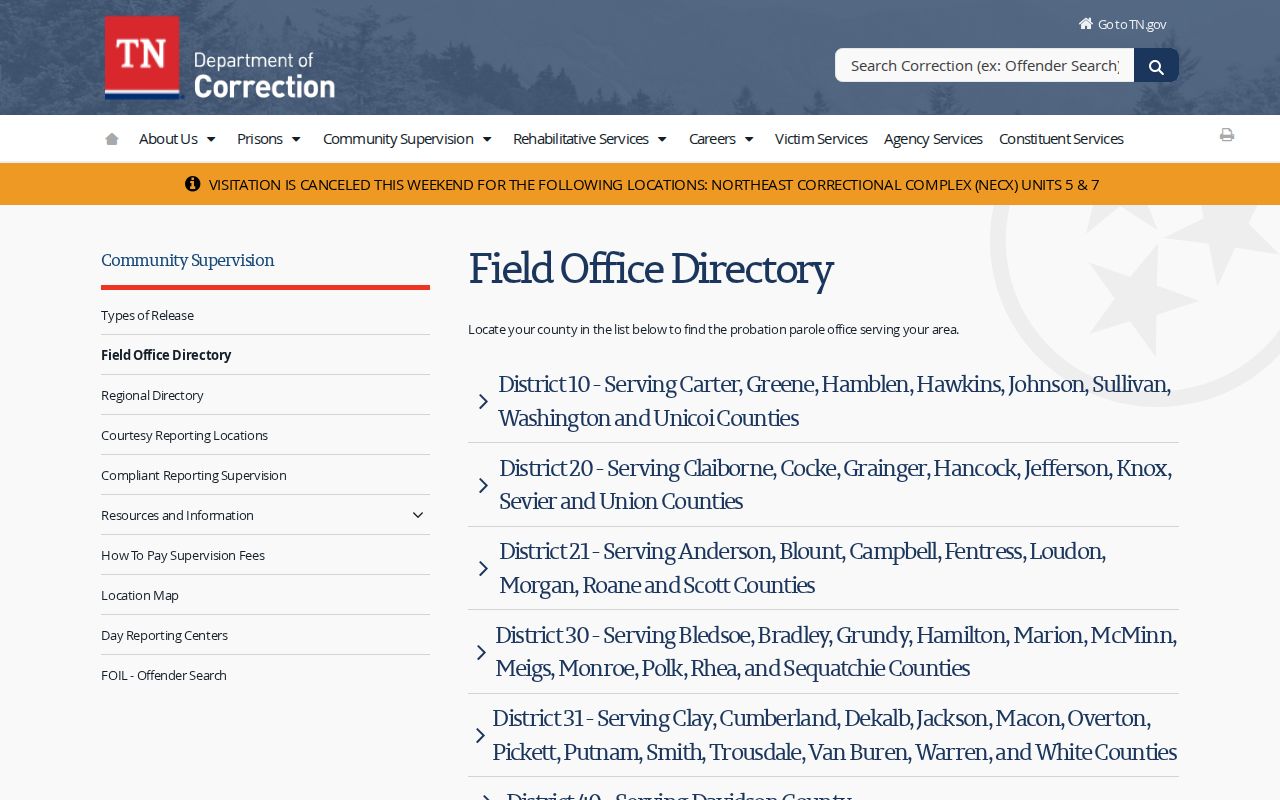
The listing ties Monroe County post-release supervision to the Madisonville office rather than to Jail Administration.
Monroe County Supervision Status Terms
Conditions are rules attached to release or a court sentence. They can include reporting, approved residence, treatment, or other terms in the individual order. A violation is an alleged failure to follow a condition. Revocation is a later decision that can return a person to custody. The source research found no general statewide public TDOC absconder or warrant list, so an absent public marker cannot settle that question.
- Parole
- Board-authorized community release while the sentence continues.
- Probation
- A court-ordered sentence served in the community, sometimes after split confinement.
- Absconder
- A person alleged to have stopped reporting or left supervision without permission; inactive does not mean absconded.
- Revocation
- A formal action that withdraws community supervision and may return the person to custody.
- Discharge
- The formal end of a sentence or supervision obligation.
The TBI Sex Offender Registry has an ABSCONDER status for covered registrants only. It is not a broad parole or probation database. A registry entry may also exist while someone is incarcerated. For a reported custody change, VINE can help, but the field office, court, or TDOC record must resolve the actual supervision event.
Monroe County Parole Hearing Records
The Tennessee Board of Parole publishes separate weekly hearing schedules for state prisons and county jails. That split matters in Monroe County because a TDOC-eligible person may be housed in the county facility. A calendar row contains the facility, TOMIS number, offender name, hearing type, and hearing date. It proves a hearing is scheduled, not that release has occurred.
The Board’s hearing process includes grant, denial, revocation, rescission, custodial, time-setting, and appeal matters. A grant may still precede plan approval and gate departure. A custodial hearing can address movement from one sentence to another. FOIL may show Parole Hearing Date and Result, but the release authorization carries the stronger physical Date of Release and Released To fields.
The Board ordinarily updates schedules weekly. Since dates can change, direct schedule questions to the Board at 615-741-1150 or BD.HearingSchedules@tn.gov. Appeals based on significant new information, misconduct, or major procedural error have a 45-day deadline after the person receives final-decision notice.
See the Tennessee parole hearing types and process reflected in the captured official page.
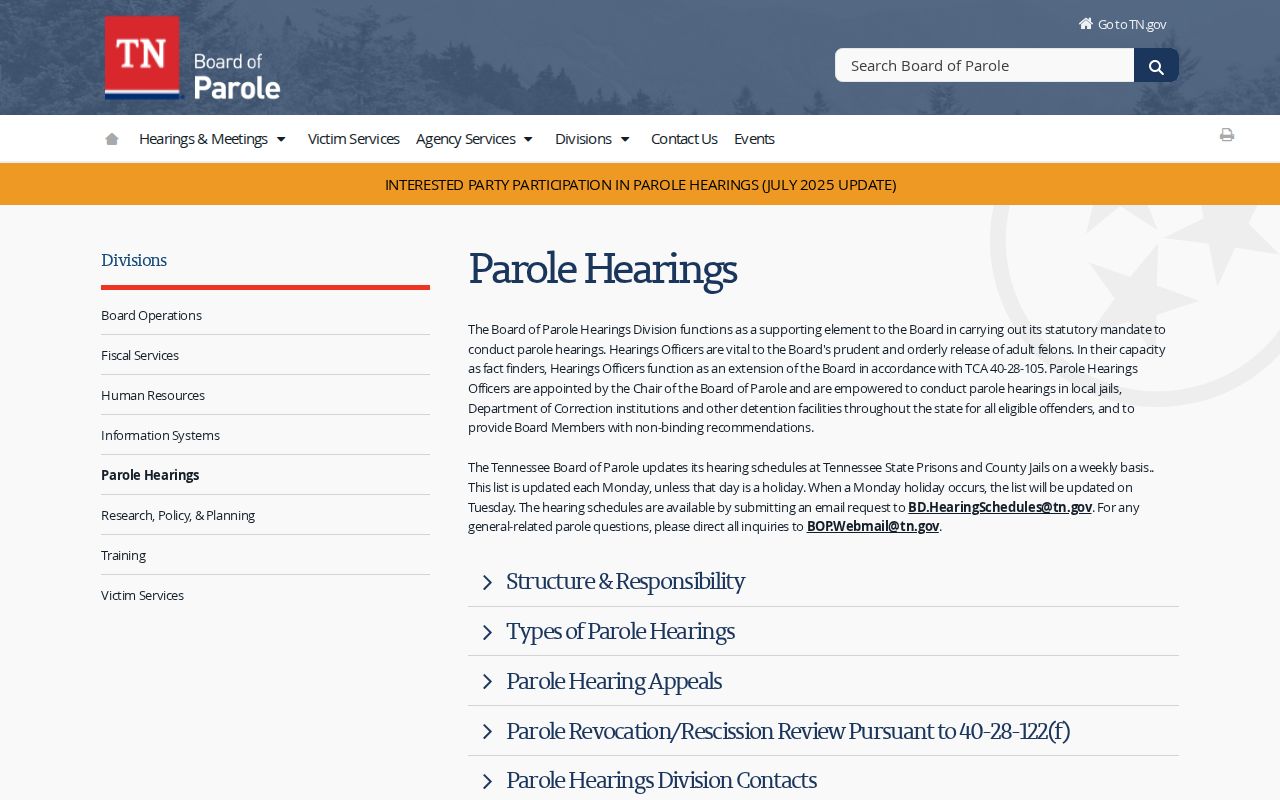
The hearing page helps decode a result without treating Board consideration as a completed Monroe County release.
Monroe County Release Reentry Programs
Monroe County’s Sheriff created a full-time Transition Coordinator role in 2024. The Sheriff’s Transition Coordinator account describes risk and needs interviews, counseling referrals, education plans, digital literacy, RDAP work, and coordination with outside resources needed at release. These services can shape a person’s transition, but they do not prove parole, guarantee an outcome, or set a release date.
The jail also documents a Freedom Class and a pilot Residential Drug Abuse Program. The first local RDAP graduation report says five participants completed the six-month pilot in November 2025. Program participation and completion must be kept separate from supervision status. FOIL, the court order, and the assigned TDOC office remain the records used to confirm Monroe County parole or probation.
Property After Monroe County Release
The Monroe County jail property rule published by Sheriff Tommy J. Jones II’s office says property is not released after booking until the inmate is released, with no exception stated on the page. That makes property release a practical marker tied to actual departure, not to a hearing date or an eligibility calculation. The Sheriff does not publish the pickup procedure, exit point, identification rule, or unclaimed-property process.
Call Jail Administration at 423-442-3911, option 3, for the local procedure. A state release uses a different record. TDOC’s CR-1947 Offender Release Authorization records the Date of Release, Released To, and checks for property, money, clothing, identification, and any state ID or license. Those operational fields help distinguish release preparation from completed release.
Ending Monroe County Post-Release Supervision
Supervision ends through a formal legal event, not because a name disappears from a jail roster. Parole may continue until sentence expiration or another authorized discharge. Probation ends under the governing court order, completion entry, or later court action. Other community statuses, such as determinate release, community corrections, Community Supervision for Life, and mandatory reentry supervision, carry distinct rules.
For a former TDOC case, an inactive FOIL record with no active Tennessee sentence supports nonactive status. It is not as strong as archived discharge documentation. Request the release or discharge file through TDOC Records Management when the final date and legal type matter. The Monroe court file can supply a probation completion or discharge entry. Together, those records distinguish completed supervision from transfer, revocation, data lag, or a record under restriction.
Ask for the narrow record that answers the question. A state request can identify the offender, sentence, release authorization, supervision history, and discharge material sought. A court request should use the docket or case number when available and identify the probation order or later completion entry. For a county release, record the Citizen Connect booking number and release date before contacting the custodian. Those identifiers reduce mistaken matches and help each office find the record it actually created.
VINE may also report parole eligibility, release, transfer, or sentence expiration as participating agencies provide data. It can alert a family member or concerned citizen to recheck the official source. It does not decide whether conditions were completed, and it cannot replace a final Board, TDOC, or court document. If VINE and FOIL differ, confirm the event with the assigned office and the record-making agency.
Note: FOIL status plus the originating court or TDOC document gives a stronger answer than either public screen by itself.